Blog Archive

Showing posts with label Superhero. Show all posts

Tuesday, September 19, 2017

Marvel Reboot Designer's Notes: The X-Men, Xavier Institute, and Mutants in General

     Children of the atom.  Mutants in the mainstream and Ultimate Marvel Universe are generally hated and feared, thanks in part to extremely loud bigots like Gyrich and Senator Robert Kelly, but also thanks to the actions of mutants like Magneto and - many insist - the X-Men themselves.  This has been especially exacerbated in recent years by Cyclops's Face-Heel Turn (Scott killed Xavier during the "Avengers/X-Men War", and Magneto has even told Scott, "You're sounding more like me than me."  When Magneto says you've gone around the bend, something's wrong.)  Plus, the X-titles tend to be rather anvilicious in their anti-prejudice outlook; while Claremont's 15-year run on Uncanny X-Men played it straight, acknowledging that the hate and fear came from a loud vocal minority, later writers and editors have decided to hammer the anvils home.
     All this is basically why I stopped reading the X-Men sometime around the Age of Apocalypse crossover in the mid-'90s.  The few times I've looked at the books since, I've found them mostly alien to me.  I decided I wanted something different yet recognizable for the X-Men.  One person claimed "the X-Men are a secret paramilitary organization with an agenda and very restricted enlistment requirements".
      Several times in the comics, the Xavier Institute has gone public as a school for mutants.  Many writers have decided to use these times to give the Institute highly forgettable students, many of whom don't last very long because of either editorial fiat, the writers not knowing what to do with them, or the readers writing in with "kill this joke off now, please!" - or a combination of all of the above!
     On top of all that, the X-Men rosters have become incredibly large and unwieldy, despite the writers focusing on a select few; the rest of the cast seems to bounce in and out, and multiple X-books have the same main characters.  (And let's not get into the annual shake-ups from editorially mandated "nothing will ever be the same" "make this darker and edgier than ever" crossovers. SO tired of them; none of the regular titles can complete a story without a mandated crossover interrupting and upsetting it.)
     So, for the Reboot X-Men, I've decided to go back to basics: The original five X-Men: Cyclops, Iceman, Angel, Beast, and Marvel Girl, in uniforms reminiscent of the ones they wore in the first run of X-Factor.  However, I've made several changes, detailed below:
  • The X-Men are not attending the Xavier Institute; they are graduates of the Institute, attending Empire State University as freshmen.  Professor Xavier is a trusted ally of the team who they turn to for guidance and assistance, but he does not give the team orders or missions.
  • Their membership roster is not limited to mutants; in addition to original first recruit Mimic, the X-Men are friends with Spider-Man and have offered him membership (he's remaining a reserve member), and Angel's girlfriend, Candy Southern, has adopted an identity-concealing outfit when assisting the team, though she hasn't taken a superheroic moniker as yet, to the point where the team's enemies and the public have begun to treat her unnamed costumed identity as a member of the team.
  • The Xavier Institute itself has gone public as a school for superhumans (not just for mutants). The Institute has about a hundred students or so, most of whom live on campus.  While the majority of the students are mutants, this is due to demographics, not a conscious effort; there are more mutants than there are legacy superhumans and new non-mutants who desire training in their abilities.
  • The X-Men will be operating in public as a superhero team, not in secret.  They will work with the authorities, and since two members - Angel and Beast - are not trying to keep their identities secret they will stick around to answer questions from police and the press, much like the Fantastic Four and Avengers are generally written as doing, rather than leaving the scene.   
    Of course, denouncing prejudice won't be absent from the Reboot X-Men, but the plan is to be a lot less anvilicious about it.  Groups like Magneto's Brotherhood of Mutants and Mystiques Mutant Liberation Front can and probably will be used as stand-ins for real-life groups like ISIS and Al-Qaeda, but the issues will be handled with more subtlty.  My preferred writer (for both X-Men and Spider-Man) is Fabian Nicieza, who handled similar topics in New Warriors v1 in the early '90s with intelligence and presenting all sides of complex issues without judgment while trying to find a compromise.
     Of course, many of the long-time X-Men from the Claremont era and later aren't going to be inactive.  Rogue is still with Mystique's MLF, though there are hints she may end up leaving the group, though whether she'll end up at Xavier's or in the X-Men proper is unknown.  Wolverine is working with an outlaw hero group, the Renegades, who are based in part off Bendis's New Avengers team.  Storm is going by her earlier epitaph Wind-Rider over in Africa, and being romanced by King T'Challa of Wakanda; I've decided that their romance was a good idea, but Marvel's handling of it was painful in that it was retconned into existence.  Far better to build it organically from their first meeting; it will also be handled in his title, not the X-book(s).  The locations and activities of other long-time members are not yet revealed.  Alex Summers/Havok and Lorna Dane/Polaris are attending the Institute; it's entirely possible that others will be attending as well.  And finally, I've decreed that Psylocke is still a student and "page three" model over in England, not a ninja.  (I'm not sure why she was made into a Japanese ninja in '89/'90, unless it was by editorial decree.)
    

Tuesday, July 25, 2017

Marvel Reboot Design Notes - Cosmic Entities

Meeting of the Cosmic Entities
     Okay, I know that so far I haven't really done any write-ups for cosmic entities - far far, the only two are Uatu the Watcher and Death, two characters on opposite ends of the cosmic spectrum.
     Marvel's cosmic entity hierarchy is in many ways a complex web and in others a complete mess, as the pic to the right should indicate (and not every entity is present), with entities introduced almost at random during the '60s through early '90s.  The only constant appears to be the visuals based on those originally drawn by Jack "King" Kirby in the '60s.  Back then we were introduced to Galactus, the Watchers, and the Stranger as "corporeal" cosmic entities, along with Eternity and the Living Tribunal an ethereal ones.  The '70s gave us the In-Betweener, Death, the Deathurge, Eon, and the Celestials.  The '80s introduced Master Order and Lord Chaosas ethereal entities who were "revealed" (read: retconned) to being responsible for the In-Betweener; the late '80s also gave us the oft-forgotten Numinus (who looked like Whoopi Goldberg cosplaying as Galactus).  The '90s introduced Infinity, the temporal counterpart to Eternity, and replaced Eon with her child Epoch (though I believe that was later reversed, going by the pic above).  And then there are things like the Phoenix Force that have undergone major retcons over the years, an ever-increasing number of Cosmic Cubes, and the Beyonder (the prototype for the ever-increasing number of "things will never be the same" company-wide crossovers).
     And don't get me started on the evolution of the Infinity Gems.

     So, as you can see, I had a lot to work with, and not all of it makes sense or plays well together.

     The main thing I needed to do was figure out who to keep and who to toss.  But to do that, I needed to make a full list and define their areas of authority, not to mention how they interact with each other.

Marvel's Cosmic Entities
     As far as I know, Marvel's cosmic entities are:
  • the Living Tribunal, the ultimate multiversal cosmic judge, and for my purposes the one responsible (from an in-universe perspective) for the Reboot.
  • Eternity, the embodiment of the physical nature of the universe.
  • Infinity, the embodiment of the temporal nature of the universe.
  • Death, embodiment of the end of all things.
  • Eon, champion of life, selector/mentor to the chosen Protector of the Universe.
  • Master Order, embodiment of the laws of physics.
  • Lord Chaos, embodiment of random chance.
  • Master Hate, embodiment of "negative" emotions.
  • Mistress Love, embodiment of "positive" emotions.
  • In-Betweener, embodiment of the balance between Order and Chaos, and between Love and Hate, among other opposites.
  • Deathurge, embodiment of the desire to give up and commit suicide.
  • Numinus, embodiment of the "never give up" attitude and invoker of a sense of wonder.
  • the Phoenix Force, embodiment of passion and the cycle of destruction and renewal.
  • Galactus, the world devourer who feeds on the life forces of planets, acts as a balance between Eternity and Death.
  • the Celestials, an ancient race of giants who experiment on a species' genetics and then return thousands of years later to judge the results; will also tend to judge any other entity below them that catches their attention.
  • the Watchers, mostly-silent observers of events, significant or otherwise.
  • the Stranger, an enigmatic giant who may be an agent of the Celestials, given that he engages in many scientific experiments for the sake of science.
  • Cosmic Cubes, along with their 'evolved' forms the Shaper of Worlds, Kubik, Kosmos, and others; the Cubes are 'infant' cosmic entities that respond to the thoughts and desires of those holding them, able to reshape reality on a planetary scale.  The evolved forms are free-willed.
  • Infinity Gems; not 'entities' in the strictest sense, but items of cosmic power that can make their owners major players on the cosmic scale.
     Of these, it is unlikely that I will be using the evolved Cosmic Cubes, Deathurge, or Numinus in the Reboot at the present time, though their existence in the greater scheme of things isn't unlikely; of the remaining entities only Galactus is actively slated for a Year Two or Year Three appearance.  The existence of the Phoenix Force will be hinted at but not seen.  I'm still not sure whether I want to use the Celestials; I've already said that I will not be using the Eternals and Deviants, but that doesn't discount the possibility of the Celestials.  Most of the others will be seen or at least hinted to exist.

Power Modifiers: Power Cosmic
     Going by the multi-tier breakdown in GURPS Powers for the Cosmic power modifier, which in the Reboot I'm calling "Power Cosmic*" to differentiate it from the other uses of the Cosmic modifer, the percentages end up as such:
* I sometimes find myself calling it the "Power Kirby", thanks to my alt.comics.lnh and rec.arts.comics.creative days of the mid '90s

     Tier 1 Power Cosmic (+50%): The Living Tribunal, the Quesada.
     Tier 2 Power Cosmic (+40%): Eternity, Infinity, Death, the Phoenix Force.
     Tier 3 Power Cosmic (+30%): Eon, Master Order, Lord Chaos, Master Hate, Mistress Love, In-Betweener.
     Tier 4 Power Cosmic (+20%): Cosmic Cubes, Galactus, Celestials.
     Tier 5 Power Cosmic (+10%): Zeus, Odin, other heads of deific pantheons, Galactus's Heralds (most notably Silver Surfer), the Watcher, the Stranger.

     Of these, I'll likely only give stats to the lower two tiers, as they are corporeal and more easily defined.  I placed the Phoenix Force as a multiversal Tier 2 since I'm playing with the idea that the Phoenix Force of one timeline is the same as all the others, hence her protectiveness of Rachel, her sole surviving daughter.

The Quesada?
      You caught that, did you? :)
      As part of the Reboot background, I created a malevolent cosmic entity that threatened the Marvel Multiverse, which I named after Joe Quesada, the former Editor-in-Chief and current Chief Creative Officer of Marvel Comics, who is responsible for such things as "One More Day" (Spider-Man selling his marriage and happiness to Mephisto to save Aunt May's life even when she was ready to die).  Quesada was one of the most hated men by the fandom ten years ago when I started the Reboot and is still held in contempt today.  I thought it was a nice "take that!" at the man, naming an entity that will appear mostly "off-camera" in exposition as causing such chaos and problems that the Living Tribunal was forced to remove most of the related timelines to prevent the destruction of the multiverse after him.

The Infinity Gems
     So where are the Infinity Gems in the above Power Cosmic schema?  As of right now - and please note that this is not set in stone - the Gems individually are Tier 5 Power Cosmic power objects, though when two or three are used together it bumps them up to Tier 4; all six together - ala the Infinity Gauntlet - I'm not sure if they'd be Tier 3 or Tier 2; I do not want to put them at Tier 1, as they are universal cosmic power objects rather than multiversal ones.

     Speaking of Thanos, I need to figure out if the Mad Titanian is himself Tier 5 or Tier 4, though at present I'm leaning towards Tier 5.

Other Notes
     Acute readers will note that I left off some known characters of a more mystical beat that could possibly interact with cosmic entities on their own level: Cytorrak, Aggamoto, Gaea, Chthon, Set, Mephisto, etc.  I'll be touching upon the more mystical aspects of the Marvel Reboot in a few weeks as I hammer it out more.


Thursday, July 20, 2017

Marvel Reboot Designer's Notes - Captain America

Captain America
No Damned "Hail Hydra" Here!
     Today we cover one of the characters who deviates in biography from the mainstream version of the character, but build-wise remains fairly true to his roots: Captain America.
     Everyone knows his origins: a 95 lb. asthmatic from Brooklyn who wanted to do the right thing for his country was selected for an experiment in creating a "super-soldier", gaining a shield and wearing a suit based on the American flag.  From the beginning in Captain America Comics #1, published in March of 1941 (long before the United States joined World War II; I need to edit the entry with the correct date), Cap has stood for the best of American values.  Not to turn this into a political rant, one of the things that worries me is that the writers are unable to recognize what those values are.  (Personally, I feel it best to make Cap a more moderate or centrist character than pulling him to one extreme or the other, admittedly an unwelcome viewpoint in today's highly polarized political climate.)
     Captain America underwent a personality shift in the 1950s, becoming more jingoistic.  This is perhaps why in Avengers v1 #4 (cover date March 1964), Marvel decided to retcon Cap's post-war appearances altogether into being others who had taken on the identity in his honor, having Cap revive from being frozen in ice since 1941.  Due to the sliding time scale, Cap's gone from being frozen in ice 19 years ('45 to '64) to currently 57 years ('45 to 2002, "fifteen years ago").  Of course, once every other decade or so someone at Marvel decides to remove the super-soldier serum from his body, causing it to break down and age to his "true" age; one of these days they'll realize he should be dead next time they pull that (but even then I don't doubt he'll "get better"; he's died once already, after all, and came back).
     In the Reboot, perhaps the one thing that's confused people a lot is why I have Captain America not frozen in ice.  It seems like a trivial thing, right?  Let's just say that I saw storytelling potential with a Captain who instead of skipping past the last 70 years had lived through it all, aging very slowly compared to everyone else, and was living in relative obscurity as a high school history teacher (ironically at the same school Spider-Man and his classmates attended).  Since he lived the time, did he marry Peggy? (I decided "yes".)  Did they have kids? (I figured they had a son, named after Bucky.)  Where were Peggy and the kid(s) now?  Did Cap outlive them?  (I decided to have Peggy die and the son MIA during 'Nam.)
      Most importantly, what was Cap's current mental state?  Steve's oldest still-active friend - Namor, King of Atlantis - probably has little time for reminiscing, having a nation to run, and most of his other wartime friends are probably getting on in age, if they're still around.  ("I'm ninety years old; I'm not dead." - Captain America: The Winter Soldier)  Cap's wife has been dead for decades, and his son missing in action and presumed dead almost as long.  Most of his old war enemies are no longer around to harass him, though I decided that their grandkids are holding onto those grudges, which provides the impetus to pull a somewhat disconnected Cap back into action.
     This also lets me play with one of my "original" characters, a version of Bucky unrelated to any of the others who have held the name: Rikki Buchanan, a Hispanic girl from his class who takes it upon herself to be his sidekick in order to get him out into the world.  (I based Rikki partially on the Heroes Reborn Rikki Barnes, Bucky Barnes' granddaughter from the alternate timeline created by Franklin Richards, but other than the similarity in names she's an original.)


Defining "Peak Human" Abilities

     In the Reboot, I have it set up so that DX, IQ, and HT cap at 15 for characters who are not considered "superhuman" in those regards; ST caps a little higher, at 23 (for a two-handed lift of 800 lbs, which the Marvel Handbooks have traditionally defined as "peak human strength", shared by Captain America and Black Panther, among others).   Steve isn't exactly superhuman, so I figured his DX and HT should cap at 15 due to the effects of the serum, and then I increased his DX to 16 due to experience and muscle memory.  I put his IQ at 12 not because he's of above-average intelligence, but because his experience makes many IQ-based rolls easier for him.  (A good comparison would be Kup from the animated Transformers: The Movie: pretty much everything reminds him of something else.)
     Cap's other serum-based abilities are Double-Jointed, Extended Lifespan 3 (x8), and Rapid Healing.  Nearly everything else on his sheet is a result of training.


The Shield

     As far as being a thrown weapon, Cap's shield is designed as an oversized discus, stats for which appear in GURPS Martial Arts and GURPS Low-Tech, and adjusted for a discus designed for an SM +2 creature using the scaling rules in GURPS Low-Tech Companion 2: Weapons and Warriors.  After that, I looked to determine which material modifiers to give it: Cap's shield has been described as being made of Vibranium or an indestructible Vibranium-steel or Adamantium-Vibranium alloy.  For my purposes, I had to define a number of common technologies in the Reboot Universe, noting that Adamantium and Vibranium are normally mutually exclusive modifiers.  In this case, I ignored that (self-imposed) rule and hit it with both, as it possesses the properties of both materials: practical invulnerability and the ability to absorb vibrations including impacts.
     I could have defined the shield as a series of advantages with Gadget modifiers, but I really really really dislike statting up equipment usable by anyone as a set of advantages.


Thursday, July 13, 2017

Marvel Reboot Designer's Notes: Ant-Man

The Astonishing Ant-Man
     Hank Pym.  Scientist.  Engineer.  Inventor.  Mentally unstable.  Reputed wife-beater.  Has had six heroic identities: Ant-Man, Giant-Man, Goliath, Yellowjacket, Doctor Pym, and the second Wasp (when Janet was dead... long story).  Also (in the comics, not the MCU everyone seems more familiar with) the creator of Ultron, and was once acknowledged by the cosmic powers as Earth's Scientist Supreme - because he achieves through science what should be scientifically impossible (though Loki later claimed to have been impersonating Eternity, remember that this is Loki; nothing can be taken at face value where he's concerned).
     One of the things I wanted to do with the Reboot was to redeem Hank.  Despite it being acknowledged as an artist misunderstanding the writer's intent - Hank was supposed to flail about and accidentally hit Janet, which turned into a full-on send-her-flying backhand - Hank has never been been able to lose the stigma of being an abusive husband.  (This later crept into the Ultimate Marvel imprint which got quite graphic in his abuse of Janet, right down to a can of bug spray!  I'm sorry, I never did like the Ultimate Marvel imprint, and this is just a minor example why.  Except for in the Spider-Man titles, everyone was either a sociopath or too dysfunctional to live!)
     So, the first thing I did was to reset the clock.  Back when he was introduced in 1961 (Tales to Astonish v1 #27, cover date January 1962, probably published in September '61), even before taking on the Ant-Man identity, Pym was a bachelor; Janet hadn't yet been introduced. Mainstream!Hank is divorced from Janet, Ultimate!Hank started off married to herI turned the clock back only slightly; Reboot!Hank
     The next thing I did was to make him much less mentally unstable.  In the comics, he's suffered from schizophrenia (which is why he became Yellowjacket in the first place), though that didn't happen until '68 as the Silver Age was beginning to give way to the Bronze Age.  Mine just suffers from an inferiority complex; he's constantly holding himself up to folks such as Reed Richards, Tony Stark, and Dr. Doom, and seeing himself come up short.  In many ways, this is a callback to his time between Yellowjacket and Doctor Pym, Scientific Adventurer, from the early West Coast Avengers.  This could make him (or anyone for that matter) slightly irritable at times.
     Although it's his longest-lasting identity, as he keeps coming back to it, I don't think I'll make him Giant-Man just yet, if at all.  In the comics, he was turned into Giant-Man by the writers because the artists kept forgetting visual cues to his reduced height, so that he didn't appear to be any different from anyone else in a skin-tight bodysuit; from an in-universe perspective, he became Giant-Man because he felt inadequate next to Hulk, Thor, and Iron Man.
     In the comics, he started out as a chemist; I've turned him into a physicist because of the nature of the "Pym Particles" used.  He's one of the best multidisciplinary scientist/inventors on any Marvel-Earth, really second only to Reed and Doom.

Defining the "Pym Particles"
     The following is pure "rubber science", if not outright "superscience".  The key here is not to get the science 100% correct, but to make sure that it is not blatantly wrong!  I am trying to keep it plausible and internally consistent, not necessarily scientifically accurate.
     The size-changing powers in the Marvel Universe are all attributed to the interactions of a sub-atomic particle known as the "Pym Particle".  This particle interacts with matter to permit access to a sidereal aspect of the universe where mass is "virtual" or "potential".  This sidereal aspect can also be used to add mass to an object, increasing size and/or density.
     Because of this, mass shunted to the sidereal dimension is stored as virtual or potential mass rather actual mass, and is still tied to the object it was originally a part of.

A Full Set of Size-Changing Powers
     Ant-Man has two main powers: the ability to shrink down to 1/2 inch size while retaining his full strength, and the ability to converse with ants and other "higher" insects (such as bees) via a cybernetic helmet; he also had the shrinking powers as Yellowjacket and Wasp.  As Giant-Man and Goliath he can grow to about 250 feet tall, with a proportionate increase in strength, though his usual combat size tended to be in the 10 to 25 foot tall range.  As Doctor Pym, he was able to cause objects he was touching to grow and shrink.  What follows are write-ups for some of the abilities I came up with for Pym and others who had similar abilities.

Size Reduction
12/27/43/57/77/92/114/130/156/173 points for levels 1-10
     This ability allows you to reduce your size by one Size Modifier per level while retaining your full HP and damage capability.  Normally you can carry up to your light encumbrance with you.  The shift takes only a second.

Statistics: Shrinking 1 (Can Carry Objects: Light Encumbrance, +20%; Full Damage, +100%; Full HP, +30%; Super, -10%) [13]. Level 2 adds "Variable, +5%" and "Reduced Time 1, +20%" [27]. Every two levels after adds another level of Reduced Time (+20% per level).

Shrink Object
45 points at level 1, +5 points per each additional level
     This ability allows you to shrink an object up to the SM difference specified by the level of the ability. The objects shrunk by this ability remain that way indefinitely until you specify otherwise.

Statistics: Affliction 1 (HT-0; Accessibility (Not On Living Beings), -20%; Advantage (Shrinking 1), +50%; Cancellation, +10%; Extended Duration: Permanent, +300%; Low Signature, +10%; Melee Attack: Reach C, -30%; Persistent, +40%; Super, -10%) [45]. Each additional level adds another level of the Advantage (+5%) [+5 points per level].

Giant-Man
94/191/267/349/440 points at levels 1-5
     You are able to grow in size. Each +1 to SM is accompanied by an increase in not only size but also ST, DR, and Injury Tolerance (Damage Reduction).  In a more "realistic" game, the fourth level (roughly 10 yards/30 feet tall) will be the maximum level before the character becomes unable to support his weight under an Earth gravity, due to the Square-Cube Law.

Statistics: Growth 1 (Super, -10%) [9] plus Extra ST +5 (Growth Size, -10%; Super, -10%) [40] plus Injury Tolerance (Damage Reduction /2; Super, -10%) [45].  Each level adds one level of Growth [+9/level].  In addition, at level 2 increase IT:DR to /3 [68] and increase Extra ST to +15  with Growth Size (-20%) [105]. Level 3 increases IT:DR to /4 [90], and Extra ST to +25 with Growth Size (-30%) [150].  Level 4 increases IT:DR to /5 [113], and Extra ST to +40 with Growth Size (-40%) [200].  Level 5 increases IT:DR to /10 [135], and Extra ST to +65 with Growth Size (-50%) [260]. Greater sizes are available; increase IT:DR to the next level, and increase Extra ST, with a final ST score calculated by taking 5 times (the final height in yards) and subtracting 10.

     I have to be honest; I haven't yet given Reboot!Ant-Man more than the Size Reduction ability.  I built the others for a Hank Pym expy character I played in a game (which ended after two sessions when the GM decided to start world-building mid-session than running the plots, because he objected to a player OOCly using "google" as a verb because it didn't fit his "throw out your frame of reference" vision...).

Super-Normal Traits
     Even without his powers, Hank would be an excellent super-normal scientist/inventor.  This was most apparent in his "red/purple jumpsuit" days as "Doctor Pym, Scientific Adventurer", and also came into play during his time as the second Wasp.  For the Reboot, I've maintained his invention ability, giving him Artifice Talent 4, Gadgeteer (though not Quick Gadgeteer), and Inventor!-16 (with a note for a conditional +4 from Artificer; it's not RAW, according to Power-Ups 7: Wildcard Skills, to combine Talents and Wildcard skills like that, but I haven't found it to break anything by permitting Talents to have conditional bonuses.

Thursday, July 6, 2017

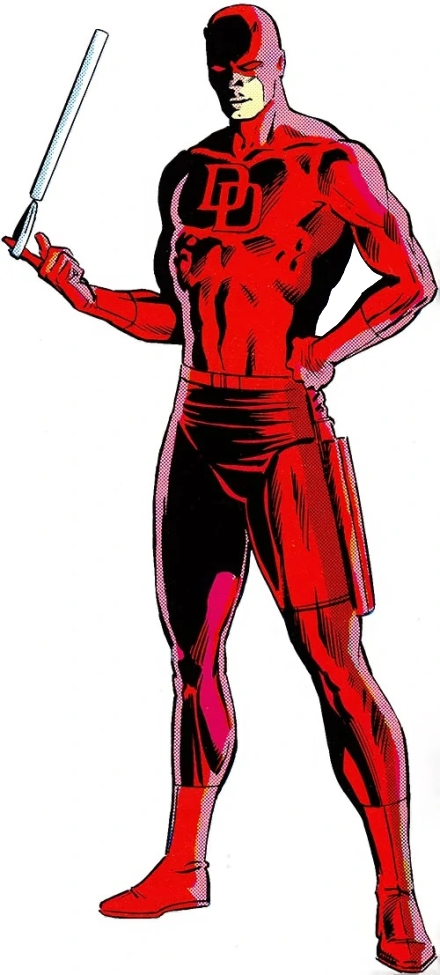
Marvel Reboot Designer's Notes: Daredevil

Daredevil - The Man Without Fear
     Always in Spidey's shadow, coming in second to the wall-crawler, even on my blog. :)
     Seriously, however, Daredevil presents a challenge to stat up, in that no two creative teams can agree just how his "radar sense" works.  In some instances, it's akin to a passive sonar, in others it seems like actual radar; yet in others it's regular "vision", but in either black-and-white or in color.  One creative team went so far as to permit him to view photographs and projected images, when most others - and every instance in the Official Handbooks of the Marvel Universe from 1984 to present - have said he cannot view such images.  On top of all that, regardless of how his radar sense works, he has his other enhanced senses: hearing that can listen to heartbeats and breathing as a kind of truth detector, fingers sensitive enough that can read regular type print (not just braille), and the ability to sift through the various different odors in the air (for example, to tell what someone had for breakfast that morning).
     So, clearly a judgement call has to be made after sifting through the various methods depicted, and this call is not going to please everyone, as everyone has their own ideal version of DD.

Daredevil's Power Set
     In order to recap from the Reboot entry, Daredevil possesses the following traits:
          Catfall (Biological, -10%) [9]
          Discriminatory Hearing (Passive Biological, -5%) [15]
          Discriminatory Smell (Emotion Sense, +50%; Passive Biological, -5%) [22]
          Discriminatory Taste (Passive Biological, -5%) [10]
          Para-Radar (Extended Arc: 360°, +125%; Super, -10%) [86]
          Parabolic Hearing 3 (Passive Biological, -5%) [12]
          Perfect Balance (Passive Biological, -5%) [15]
          Sensitive Touch (Stethoscopic, +50%; Ultra-Fine, +30%; Passive Biological, -5%) [18]
          Vibration Sense (Passive Biological, -5%) [10]
          Blindness [-50]
      Note that these do not include his combat training.
      I used Passive Biological (-5%) on most of his stuff to indicate that various pharmaceuticals can be developed to disable these powers.  Biological (-10%) is used on Catfall, which in addition to the pharmaceuticals knocking them out he indicates he has to spend 1 FP per use.  (Given how he's been known to fail to land properly when winded (suffering from a loss of FP due to prolonged combat and other feats), it seems to make sense.)

      Now, by the RAW, Blindness (p. B124) gives -6 to all combat skills, which is in essence a "darkness penalty" for total darkness but bought off slightly by those who have the disad a while (indeed, the text for the disadvantage states that if you acquire it suddenly, you're at -10 as if in total darkness).  However, the text for Scanning Senses (which includes Para-Radar, a kind of undetectable radar; p. B81) says that since it doesn't have anything to do with sight one can ignore darkness penalties when using it.  This is complemented by his Vibration Sense.
     Honestly, his enhanced senses were easier to determine than his radar sense.

    Now, I recently got hold of a copy of GURPS Powers: Enhanced Senses.  I'm going through it to see how his abilities should work out, and will probably revise the power set in the future.

Why a District Attorney?
      When I started work on Matt Murdock (rather than his heroic vigilante alter ego of Daredevil), I had the idea that Matt would be working to protect the innocent (as he has always done) in the sense that he'd be working in the legal system to not only keep the falsely accused innocent from prison but also help put the guilty behind bars.  He can't really do that as a defense attorney, as he'd only be involved with the bad guys in civil cases.  However, working in the NYC District Attorney's office as a prosecutor would work.  Keeping Foggy as a defense attorney was easy; as a Public Defender, he could easily be working opposite sides of the case from Matt, which in itself can lead to some nice courtroom drama scenes - particularly if Matt's being forced by his bosses to prosecute the wrong person.
     So what about Nelson & Murdock, Attorneys-at-Law?  Part of me is thinking that the two are considering it in the backs of their minds, but the idea that the bulk of their client base would be civil suits and pro bono cases assigned by the court just doesn't seem to fit the title as yet.

Wednesday, June 28, 2017

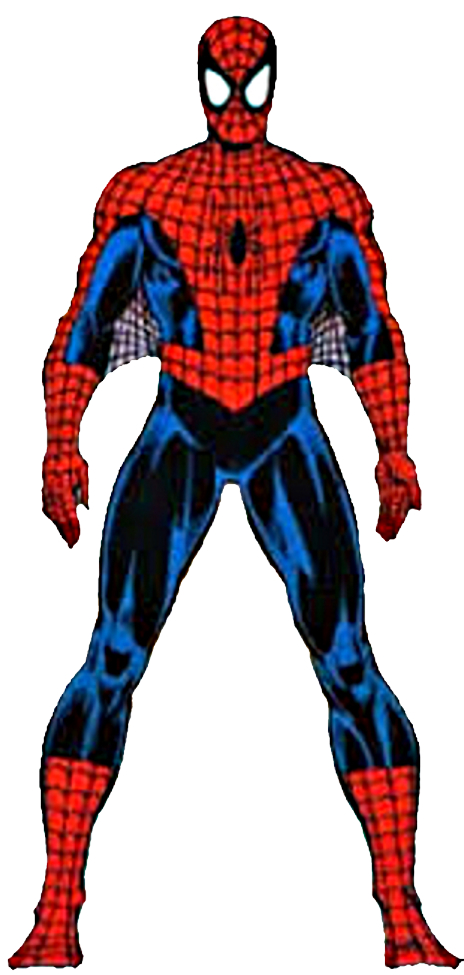
Marvel Reboot Designer's Notes: Spider-Man

     As many of the regular followers of this blog know, I'm working on a GURPS Marvel Comics Reboot project on the side, which has been going on for the past 10 years.  (I started in '07; has it really been that long?)  Today, I begin work on a series of Designer's Notes for various characters in the Reboot, starting with our friendly neighborhood Spider-Man!
Our Friendly Neighborhood
Spider-Man
     The biggest complaint I receive emails about for Spidey's Reboot is "how dare I make Pete a college student!  He's supposed to be a high school teenager!"
    First, with the exception of the Ultimate Marvel imprint and various other media Pete hasn't been in high school in the comics since the mid-1960s!  At the time I read his titles - during the height of the comics craze from the mid-'80s through mid-'90s, when he had four concurrent titles (Amazing Spider-Man, Spectacular Spider-Man, Web of Spider-Man, and Spider-Man) - Pete was a college graduate student pursuing his Masters of Science degree in Chemistry at Empire State University (Marvel's fictitious university on the south end of Manhattan) and married to Mary Jane, who was expecting their first child (a daughter they named May after Pete's Aunt May).  Gwen had died in '75 (an action nearly universally held as the start of the Bronze Age of Comics).
     It's only the Ultimate Spider-Man titles and the movies put out post Spider-Man 3 that have him still in high school.
     In my case, I cannot relate to a high school aged Spider-Man.  It's been far too long since I was in high school (late '80s), and as I said the Spider-Man I know and love was an adult.  I also realized that making Pete a graduate student would alienate the fans who see him as a perpetual teenager.  So I split the difference: I made him a college freshman, just out of high school, and new to his powers.

Defining Spider-Man's Powers
     Speaking of his powers, everyone knows Spider-Man's origins: bit by a radioactive spider, he gains the proportionate strength, speed, and agility of a spider.  There's just one problem with that situation, which please permit me to paraphrase Futurama:
RADIATION DOES NOT WORK LIKE THAT!
     Ahem, sorry.
     There have been different attempts to explain Spidey's powers in the comics and movies that recognize this aspect, from the bite transmitting a genetic retrovirus that rewrote his genetic code to the bite conveying unto him the post of "champion of the spider totem".  For the Reboot, I've decided to take a page out of the Sam Raimi/Tobey Maguire Spider-Man movie trilogy and make the bite inject him with a genetic retrovirus which augmented his DNA.
     Spidey's classic power set is essentially as follows: Superhuman strength in the "10 ton lift" range, superhuman agility, the ability to stick to most surfaces the way most insects and spiders seem to be able to, and a "spider-sense" which enables him to sense danger just before it happens.  One lesser-known power is the ability to see bullets in flight, which is generally considered part of his spider-sense.  He is also generally more durable than most, given the beatings he often takes.  The Sam Raimi/Tobey Maguire movie trilogy also gave us the idea that his webbing was innate; most other depictions have him using mechanical web-shooters using a chemical formula he invented. I have chosen in the Reboot to go with the Raimi/Maguire explanation for the time being.
     To begin with, let's review what I have as his powers:

     Attributes: ST 22/112 [20*]; DX 12/18 [40†]; HT 12 [20]..
     Secondary Characteristics: Dmg 2d/4d (12d/14d); BL 97 lbs. (2,509 lbs/1.25 tons); HP 22 [0]; FP 20 [24]; Basic Speed 6.00/8.00 [0]; Basic Move 6/8 [0]; Brachiation Move 4 [0]; Dodge 9/15.
     Advantages: Binding (Webbing) 20 (Sticky, +20%; Super, -10%) [44]; Clinging (Passive Biological, -5%) [19]; Danger Sense (ESP, -10%) [14]; Enhanced Dodge 3 (ESP, -10%) [41]; Enhanced Time Sense (ESP, -10%) [41]; Extra DX +6 (Super, -10%) [108]; Injury Tolerance (Damage Reduction  /10; Limited: Crushing Attacks, -40%; Super, -10%) [75]; Perfect Balance (Super, -10%) [14]; Super Jump 2 (Super, -10%) [18]; Super ST +10/+100 (Super, -10%) [360].
     Perks: Climbing Line [1]; Swinging [1].

     * Includes +10/+100 from Super ST.
     † Includes +6 from Extra DX.

     Allow me to go into detail on a few items:
     First, his superhuman agility.  You'll note that I have his DX split, 12/18, resulting in his Basic Speed, Basic Move, and Dodge also being split (6.00/8.00, 6/8, and 9/15 respectively).  His Extra DX +6 has a power modifier (Super, -10%) on it, which means that in rare cases where his powers are negated he essentially still has an above-average DX score (12).  In the Reboot, I've decided to cap DX, IQ, and HT at 15 unless those traits are deemed to be "superhuman".  This makes Spidey's typical DX 18 effectively superhuman. Assisting in his superhuman agility are Perfect Balance and Enhanced Dodge 3, the latter of which enables him to most blows.
     For his superhuman strength, Pete has a wiry physique; he doesn't look muscled, but there's also almost no body fat.  With his powers, he's able to lift a 10-ton car over his head with effort using both arms.  Reverse-engineering his Basic Lift from the 2-handed lift (BLx8), we have SQRT(20,000/8*5), which gives us ST 111.8, which I rounded to 112.  Then I looked at the closest Super ST level: +10/+100.  This gave me a base ST of 12 before factoring in Super ST.  He's also said to be able to leap great distances thanks to his strength; this is handled by giving him Super Jump.  Not on the sheet though certainly plausible is giving him levels of Super Throw giving him the ability to throw items farther than he normally should be able to.
     Spidey is quite durable, able to withstand blows from superhumanly strong foes, though he doesn't come through those fights unscathed.  I've forgone the use of DR and instead went with Injury Tolerance (Damage Reduction), which I've limited to reducing the power of Crushing blows (such as most superhumanly strong punches) only.  This has the side-effect that blades, bullets, lasers, and other such effects affect him normally.
     His webbing.  I used Binding for the main effect, which is typically holding his enemies in place.  If you want to give him mechanical/chemical web shooters, I'd replace the "Super, -10%" with "Mechanical, -10%", "Electronic, -30%" (depending on whether you rule they rely on advanced electronics or are purely mechanical) or a set of Gadget limitations (including "Breakable: SM -7, -5%", "Breakable: DR 2 or less, -20%", and "Can Be Stolen/Forcibly Removed, -10%").  The two Perks - Climbing Line and Swinging - are also part of the web shooters, and work as-is regardless of whether the webbing is innate or technological in nature.  He has also been known to craft items with his webbing, but since the Reboot is a Year One reset he hasn't yet messed with that as much.  If adding those in, I'd go with using Gizmos with an Accessibility: Webbing Creations Only limitation (which I'd set as a -20% limitation, reducing Gizmos from 5 per level to 4 per level).  Another way would be to use Create Webbing and Control Webbing, with a Link on both, though I don't recommend it.
     Finally, his "spider-sense".  At first glance, Danger Sense is perfect for it.  On top of that, the ability to perceive bullets in flight is part of Enhanced Time Sense (which includes the effects of Combat Reflexes).  His Enhanced Dodge is also part of this spider-sense.

     One other thing I got bitched at a lot about was his "low" Dodge score.  Seems folks expect Spider-Man to be Dodge 18+ right from the start.  I figured people were looking at Spider-Man in the comics with over 15 in-universe years experience who has put earned XP into additional DX and Enhanced Dodge, not a Spider-Man who has had his powers for less than a year and is still learning all that he can do with them.


Next week, I'll be giving designer's notes on either Daredevil or Hank Pym/Ant-Man.  I'm also open to suggestions for others in the Reboot I've posted who folks want explanations on.

Wednesday, October 12, 2016

GURPS Supers - How to Brick

     In superhero setting parlance, a "brick" is a character who is designed to take a beating, often being described as "invulnerable", "nigh-invulnerable", or "able to withstand blows from" various sources.
The Man of Steel
The prototype "flying brick"
     One of the first actual bricks in the comics was Superman in Action Comics #1, described as "nothing short of a bursting shell could penetrate his skin".  This has waxed and waned over time; at the height of the silliness of the Silver Age, Superman could contain a nuclear explosion by literally sitting on it(!), while at the start of the Iron Age of Comics (sometimes called the Dark Age or Dork Age), Superman was killed by a creature designed specifically for the purpose of killing him (he got better...).  Generally, though, Superman is described as being nearly invulnerable to anything the bad guys can dish out, except when kryptonite, magic, and "red sun" radiation are involved, or (lately) when he's low on energy and blocked from recharging in sun.

     Other bricks in the comics are Ben Grimm/the Thing of The Fantastic Four fame, various battlesuit wearers (the Iron Monger suit developed by Obadiah Stane in the Iron Man comics), the Hulk, Thor, the Juggernaut, Giant Man, his DC/SuperFriends counterpart Apache Chief, and, though many people don't think of him this way, Aquaman.  All these characters are able to take a beating far beyond what their more human-durability cohorts can.
     MMO players may see a correlation between the MMO's concept of a "tank" and the superhero concept of a "brick".  Both are built to take a beating; the difference is that the brick is rarely designed to "grab and hold aggro" through a threat generation mechanic.  A brick will often be attacked first or hardest, but this is a general narrative idea, not a mechanical one.
     Bricks often but not always have superhuman strength as well.  This superhuman strength assists in enabling them to dish out damage while they take it.  Two bricks pounding on each other have been shown to demolish entire buildings!

Making a Brick

     The first thing to decide when making a brick is "how much damage should I be able to absorb?"  GURPS has two traits that are essential to making a brick: Damage Resistance (DR) and Injury Tolerance (Damage Reduction) (IT:DR).  Other possible Injury Tolerance traits - such as Homogeneous and Unbreakable Bones - can be used to make a brick, but they aren't essential to the concept.
It's clobbering time!
     Damage Resistance is the first trait to come to mind for making a brick.  Ben Grimm (pictured left) has Flexible and Cannot Wear Armor on his DR (supplemented with a Non-Protective Clothing Perk so he can wear pants), while Superman (above) has Tough Skin and No Signature on his DR (No Signature means his DR does not look like armor; and his is sometimes described as a Force Field, enabling him to take a bullet to the eye without blinking).
      How much DR is needed?  That depends on what you expect to run into.  Most police-issue pistols do 2d+2 to 3d damage, submachine guns and carbines can average 4d, assault rifles average 5d, and hunting and police sniper rifles can hit 7d.  Some anti-material rifles and heavy machine guns (such as the Barrett Light-50) can do 12d or 13d damage!  2d+2 damage is an average 9 damage, max 14;  3d is an average 11 damage, max 18; 4d is an average 14 damage, max 24; 5d is an average 18 damage, max 30; 6d is an average 21 damage, max 36; 7d is an average 25 damage, max 42; 12d is an average 42 damage, max 72.  If you have a setting where weapons routinely have armor divisors (the bad guys carry armor-piercing rounds, lasers, or blasters), it is often cheaper to put levels of Hardened on your DR than it is to multiply your DR by the standard armor divisor.
     So now we have our DR set against conventional firearms.  But what about those nasty 32d punches your fellow bricks and some super-strong scrappers can dish out (average 112 damage, max 192)?  If you're on a budget and can't afford that much DR, that's where IT:DR comes into play.
     Injury Tolerance (Damage Reduction) is applied after DR is subtracted from the damage and wounding modifiers from Injury Tolerance (Homogeneous), hit locations, and the damage type (commonly cutting, impaling, or the various piercing types) are taken into account.  IT:DR is a damage divisor, starting at "divide by 2" as the first level and going up from there in a 2-3-5-7-10-15-20-etc. manner.  This means that IT:DR /10 divides the injury taken from the attack by 10.  Damage after IT:DR is always rounded up, so that even if the damage is reduced to 0.01, it'll always round up to 1 damage taken.  This may seem counter-intuitive at first, but this can be used to explain how some brick type characters have bruises or are shown bleeding from the mouth or nose after taking a very solid hit.
     Let's consider a character with DR 45 and IT:DR /50.  He's attacked by a character who is doing 30d cutting damage, doing an average 105 damage.  That 105 damage is reduced by DR to 60 injury, then multiplied by 1.5 due to being cutting damage to 90.  After that, the damage taken is divided by 50, to 1.8 damage, rounded up to 2 injury taken.

Bricks and Superhuman Strength
     Many bricks are shown to have superhuman strength; in fact, superhuman strength and effective invulnerability go hand in hand.in the comics and many movies (think about how often the Hulk is actually injured).  Most bricks start their ST at 20 (due to mass alone, if following some form of the square-cube law for mass and size) and Super ST adds to that; a typical brick in GURPS has Super ST +12/+200 or better, though some get up to Super ST +15/+700.  If there's no point limit, some bricks can get up to ST +20/+5000 (think about how strong the Hulk or the Silver Age Superman can get, and you may realize that may actually not be enough strength for some of their feats!).  A D-scale or M-scale brick can be incredibly strong, and be just as invulnerable as their DR and IT:DR can also get in the thousands or even millions.
     Of course, there's healing to consider.  Many bricks - Superman, Hulk, and Thor, to name some notable ones - heal a lot faster from injury.  This is best represented by using Regeneration (Fast: 1 HP/minute) or faster; Hulk himself may top out at Regeneration (Extreme: 10 HP/second).  And since a superhuman brick will have 20-40 HP, the Regeneration is multiplied by 1/10 the HP value; 20 HP makes Regeneration (Regular) renew 2 HP/minute, not 1; 40 HP is 4 HP/minute.  Regeneration (Extreme) for HP 40 is 40 HP/sec, meaning that the damage taken is removed almost immediately.
     Many bricks also have levels of Super Throw, enabling several of them to use telephone poles as javelins ("Let me get this straight, Mr. Grimm: you threw a what through where to hit who?")  Bricks excel at melee, but their ranged ability is either really short-ranged (Superman's heat vision and cold breath) or throwing random objects to get their flying opponents on the ground.  Some (I'm looking at you, Hulk!) also have Super Jump, but in essence they're ground-based fighters.

     A brick's ST, Super ST, HP, DR, IT:DR, and Regeneration levels are limited by the point value of the game.  Because a brick's traits are not cheap and need to be taken in large levels, I tend to permit bricks to apply 50% more points than others in the game; for a high-powered (Justice League, Fantastic Four, original Avengers) 1000 point game, this means the brick is built on 1500 points; for a typical 500 point game (New Teen Titans, Young Justice, X-Men), the brick is built on 750 points, and for a street-level (Batman, Green Arrow) 250 point game, the brick is built on 375 points.  Of course, the lower levels limit just how effective the brick can be, but 375 points can produce a character that can shrug off police handguns with ease, while the 1500 point brick can withstand tank shells without flinching.

     A final thought: a brick is a simple yet relatively expensive superhero build.  They can be fun, but be aware of both their strengths and limitations.  Not every flying brick is Superman, and not every ground-based brick is the Hulk.  But when things need to be beaten up while taking very little damage yourself... it's clobbering time!

Friday, October 7, 2016

The Battlesuit Hero

    One of the classic hero types since the Silver Age of Comics is the battlesuit hero.  Unlike most hero types, who are either non-powered that rely on skill and use mostly "mundane" technology (such as Batman and Hawkeye) or have innate powers (Superman, Spider-Man), the battlesuit hero relies almost entirely on a suit of powered armor, typically with built-in weaponry.  The most iconic of the battlesuit heroes is, of course, Tony Stark/Iron Man; there are others, of course, owned by Marvel, DC, Image, and smaller companies.
    There are four basic methods to produce a battlesuit hero in GURPS: Signature Gear, a set of Advantages with various Gadget modifiers, as an Ally, and as an Alternate Form.  I'll discuss each of the four methods.

Signature Gear
    The Signature Gear method is the simplest of the four methods used to build such a character: build the battlesuit as a piece of gear, determine its price tag, if necessary adjust for being a higher TL item, and purchase the whole thing with the Signature Gear Advantage.
    On the one hand, this method may be preferred due to its simplicity.  However, this method requires that the battlesuit has a price tag.  If using one of the suits in GURPS Ultra-Tech or adapting from a design built using GURPS Classic: Vehicles or GURPS Classic: Mecha, the price in G$ is relatively easy to obtain.  On the other hand, it is not always appropriate for one-of-a-kind suits (like most of Iron Man's suits).
    As an example, let's take a TL10 Commando Battlesuit (Ultra-Tech, p. 183, 186).  At TL10, it costs $80,000; in a typical modern-day superhero setting this could appear at TL8 as a prototype.  Due to being two tech levels above the setting, the price is quadrupled, for $320,000.  At TL8, each point in Signature Gear nets a value of $10,000; this means the suit requires "Signature Gear (Commando Battlesuit) [32]".  In addition, Signature Gear means the suit has some form of "plot protection", enabling it to get replaced if stolen or destroyed.
    This cheap price can be useful in a fairly low-powered (250 points) setting.  I don't recommend using this method for 500+ point campaigns.

As an Ally
    As explained in The Captain's Boat (Pyramid #3/71, pp. 32-33), a vehicle - and here I count battlesuits, especially those supported by an integral AI - may be purchased as a base 5-point Ally, without adjusting for Frequency of Appearance.  More customized battlesuits can be built with a higher base Ally cost.
    For a battlesuit hero on a strict point budget (say, 150 points), this can be considered the most cost-effective method.  On the other hand, it is often considered a "point crock," as it makes owning or operating a battlesuit too affordable for some games; a character can get a major benefit for only a handful of points.

Advantages with Gadget Limitations
    The method taken by GURPS Supers is to treat the battlesuit as a set of Advantages, each possessing the "Gadget/Can Be Stolen (Must Be Forcibly Removed) (-10%)" limitation, often accompanied with a few Temporary Disadvantages (Electrical, Maintenance, and Unhealing are common).
    From the point of view of point costs, this is one of the fairer methods, especially when compared to various brick and blaster builds.  However, it can be a pain during character generation, especially when trying to add the limitations for every advantage in the suit.  To offset this, I recommend using a variation of the "Meta-Enhancement" rule from GURPS Power-Ups 4: Enhancements, treating a set of limitations as a single "Meta-Limitation", writing just the Meta-Limitation name (e.g. "Battlesuit, -40%") on each advantage, and a note on the sheet detailing which limitations are used.
    This method often has other questions asked during character generation: "If a part of the suit has is supposed to be Gadget/Breakable, what SM is the relevant body part?" "Do I need Switchable and/or Takes Extra Time on everything in order to don the armor?"  The GM must be ready to answer these questions.  A player may get frustrated with this method and decide to choose a different type of character, one not quite so complicated.
    (Sadly, I'm currently lacking an example build, as the build I was going to use as an example has been replaced by an Alternate Form build.)

Alternate Form
    My current preferred method: build the suit as if it was a racial package and calculate it as an Alternate Form.  This lets you define the Advantages without needing to specify a gaggle of Gadget and Temporary Disadvantages.  Such traits are defined as full-fledged Disadvantages in the racial package.
    After determining the point cost of the "racial" package for the battlesuit, the Alternate Form advantage on the primary character sheet is calculated: 15 + (90% of the racial package cost).  At this point, add the Gadget/Can Be Stolen (Forcibly Removed) limitation directly to the Alternate Form trait.  If it takes longer than 10 seconds to don the armor, you can use the Takes Extra Time limitation (p. B115) to extend the time.
    On the plus side, if the character owns multiple suits he can change into, each additional suit of equal or lower point value is worth only 15 points.
    Here is one build for a battlesuit with wings:

634 points
Attribute Adjustments:
ST +24 [240].
Advantages: Clinging [20]; Combat Reflexes (Accessibility: Only On Opponents Whose Style Is Programmed In, -20%) [12]; Damage Resistance 12 (Partial: Torso and Groin Only, -5%; Hardened 1, +20%) [69]; Damage Resistance 30 [150]; Electrolaser: Burning Attack 1d (Link, +10%) [6] plus Affliction 4 (HT-3; Link, +10%) [44]; Enhanced Move (Air) 1.5 [30]; Flight (Winged, -25%) [30]; Infravision [9]; Ladar (Targeting Only, -40%) [12]; Protected Vision [5]; Sealed [15]; Telecommunications (Radio) [10].
Perks: Accessory: Personal Computer [1].
Disadvantages: Electrical [-20].

On the main character sheet, I list the following:
Advantages: Alternate Form (Battlesuit) (Gadget/Can Be Stolen: Forcibly Removed, -10%) [585]

    (Yes, this is my build for the Beetle for my Marvel Reboot project.  I would have used Iron Man as an example, but I'm still working on his suits' racial packages.)

    Each method has their own strengths and weaknesses.  Personally, I prefer the Alternate Form method for battlesuit characters, as it combines a point cost comparable with other superhero abilities with a simplistic method.

Tuesday, October 4, 2016

Designing an Effective Super-Hero in GURPS

     As many long-time readers know, I've been working on a "reboot" project of the Marvel Comics Universe since about 2007 (has it been 9 years already?!), using GURPS as the system to create the characters.  In that time, I've had the opportunity to make about 200 individual characters ranging in point value from -10 points (Turk Barrett) to over 34,500 points (the Watcher), with the majority between 200 and 3000 points.
      Of course, many of these characters weren't designed with a set point value given, and most of them have oddball numbers.  For reference, I have the original Avengers at a wide range of points: Ant-Man (Hank Pym) at 450, Captain America at 992, the Hulk at 3,654 (Banner at 13 before his Alternate Form for the Hulk), Iron Man currently at 490 (and set to skyrocket as I redo his armors from Signature Gear to Alternate Forms), Thor at 1,728 (and possibly set to go up when I get around to redoing him), and the Wasp (Janet van Dyne) at 410.  Quite the wide range of points, and only half the team at round numbers.
      So how do I go about designing the characters?  First off, I look at them in two steps: Step 1: Who are they without powers/before they got powers?  Step 2: What are their powers?  I tend to ignore point values for this genre, though in an actual game I would probably give point values.  In a game based on the X-Men, Avengers, Fantastic Four, New Teen Titans, Outsiders, or Justice League, I find a good rule of thumb for superheroes (and anti-heroes, villains, and non-villain antagonists) is about 150 to 250 points before powers, with up to between 750 and 850 points in powers, rounding the cap at 1,000 points . . . unless one is a "brick" concept (which itself has variation: Hulk, Giant-Man, Thor, Ben Grimm, and Colossus are all technically "bricks"), in which case I would assign between 1,250 and 1,350 points, bringing the character to 1,500 points.  This is because the traits inherent in a brick tend to be fairly pricey - Super ST, Damage Resistance, and Injury Tolerance: Damage Reduction in levels that make a brick viable tends to get expensive.  (I'm not one for adjusting the overall pricing of traits, because I know I'll end up breaking things on some scale.)
      For super-normals like the Black Widow, I treat their cinematic traits as their "powers".  Several of my "super-normals" are hyper-competent with high skill levels (16+), others just have a lot of skills at professional levels (skill level 12 to 14).

Start with the Concept.


     Let's take one character I had, an expy of Hank Pym from a few spots in his career: Jorge Hernandez/Hombre Gigante.  He was an inventor type with size-changing ability (based on Pym's Ant-Man and Giant-Man identities) and the ability to shrink items to carry on his person in his pockets (ala "Doctor Pym, Scientific Adventurer" from his days in the West Coast Avengers).  The GM - who was going for a somewhat grittier Iron/Dark/Dork Age type game than I prefer - agreed that the growth ability classified him as a "brick", so I had up to 1,500 points to play with; the GM was using the rules I set up for a different game, summarized above.
      Jorge ended up being 250 points with his stats, mundane advantages (including the Artificer Talent*), disadvantages, and skills.  Tacking on Shrinking to get him down to about 4 inches tall, Gadgeteer, Gizmos, Affliction (Advantage: Shrinking), and enough Inventor! skill to be useful got him to 600 points.  The rest I dumped into Growth 2, Super ST (Growth ST), DR (Accessory: Only When Using Growth), and IT:DR (Accessory: Only When Using Growth), wrapping him up at around 1500 points total.
      After that, and this is a step I rarely take with my Marvel Reboot project, I double-checked things to optimize the character, shuffling points around and raising skill levels as needed.
 * Yes, I know Talents and Wildcards are not supposed to be used for the same thing, but the GM and I both agreed that letting Talents give conditional bonuses to a Wildcard when the Wildcard was being used in place of the regular skill the Talent covers would not break things, and is relatively in-genre.

How Much DR and IT:DR are Needed For a Brick?


     That depends on what you expect to go up against. Most bricks are said to be "bullet-proof", while the primary weapons shown being used against them are pistols and sub-guns.  Most of those weapons top out at 3d damage, with 2d+1 being the average.  In GURPS, "resistant" to damage means that it stops all damage 50% of the time, and reduces the worst damage by 50%.  In a 3d pistol's case, such as the .50AR Desert Eagle, DR 10 is enough to resist damage, and DR 18 is 100% proof against it.  Getting up to rifle rounds, the typical assault rifle does 5d damage, while police snipers and hunting rifles do 7d; therefore DR 18 is resistant and DR 30 fully proofed against assault rifles, while for snipers DR 25 and DR 42 are the numbers to resist or be fully proofed, respectively.
      Because many supers run into lasers of some sort at some point in their careers, adding a few levels of Hardened to the DR isn't out of genre for bricks.  Also, while I do not add No Signature to my own bricks, it may be useful for folks like Superman and Captain Marvel (both Marvel's and DC's) whose "armor skin" doesn't appear to be "armor" at first glance.
      Bricks also tend to hit rather hard, and a brawl between bricks has been known to demolish buildings without the bricks taking much damage themselves.  This is where Injury Tolerance: Damage Reduction on top of DR comes into play.  DR reduces the damage taken by a set amount, but a brick may do about 40d damage (average 140 damage, max 240), and is expected to be able to take similar hits as well as dishing it out.  (Very few 'bricks' are actually 'glass cannons'; it's just not in-genre!)  IT:DR reduces the rest of the damage taken not by a set amount but to a fraction.
      For example, I gave Jorge IT:DR /50 and DR 25, not counting the DR from his uniform (DR 12/4*, with the 12 being against piercing and cutting, and the 4 everything else).  So against a 40d (140 damage) punch he reduced the damage from 140 to 111, then further reduced it from 111 to 2.22 (I have to double-check to see if that rounds to 2 or 3).  Given his Growth Super ST raised his ST from 12 to about 30-ish, that was barely a tickle.
      So a brick needs a lot of DR and IT:DR; take as much of both as your GM allows.  Super-strong scrappers like Spider-Man rely more on their IT:DR, often with "Crushing Only, -40%" on it.

Balancing Blasters and Bricks 


     Blasters are your glass cannons; they dish out damage but really can't take much.  They occasionally do wear armor of some sort or have abilities that provide it, such as the Human Torch's fiery aura, but for the most part they're relying on the bricks to take the damage while they dish it out.  One thing I've been - perhaps rightfully - accused of in my Marvel Reboot project is making my blasters fairly weak compared to bricks.  Most of my blasters do damage in the handgun to rifle range, with 3d to 7d damage being typical.  One has a 6d×3 burning explosive attack, but that attack also drains the character of his FP when using it.
      So, how do you balance a brick who can punch for 30d and a blaster who shoots for 8d?  If the brick fights the blaster, the blaster gets pulverized, unless the brick pulls his punches.  The trick is letting the blaster hang back and not get into melee at all.
     Another option, which may be viable in a setting, is to let the blaster buy a 30d ranged attack and build it with Variable (+5%), letting him dial back the attack so as to avoid hitting others with pulverizingly lethal attacks.  Such a blaster is still a glass cannon, but he's better able to harm the bricks that have a load of DR and IT:DR.
      Most blasters, however, work in conjunction with what are known as controllers, those that act as "battlefield control".  An classic example is Cyclops of the X-Men working with Iceman and Marvel Girl, both of whom helped keep the bricks at bay so the blasters can hang back, letting the scrappers and fellow bricks close to melee.
      Remember that in most cases, a hero team is not built as a bunch of solo heroes; they're made with the intent that the heroes work together and playing to each others' strengths.

Scrapper?


     Scrappers are basically your melee glass cannons.  Spider-Man and Batman are both technically scrappers.  For a scrapper, you want to deliver your damage in melee; this can be either a weapon with Weapon Master, an Innate Attack with a Melee Attack limitation, or some combination of a striking skill (Brawling, Boxing, or Karate), Trained By a Master, Striker, Striking ST, and/or Super ST.  Defensively, you want to load up on Enhanced Defenses, particularly Enhanced Parry and Enhanced Dodge, though shield-wielders like Captain America love their Enhanced Block.
      Some IT:DR on the scrappers isn't a bad deal, as it lets them survive blows by bricks that inevitable connect, but most will lack DR unless they wear armor, and not many wear the right amount of armor to take hits from a proper brick.

Well, that's all for this week.  Next week, I promise I'll give an example brick or three.

Thursday, August 11, 2016

Superhero Game Power Modifiers - What, When, and Why?

Anyone running a superhero game - or any game with power modifiers for that matter - will want to look at various power modifiers and ask themselves: Who gets what power modifier, when do they come into play, and why are power modifiers a thing for this?

The "why" is easy to explain: Power modifiers are a thing because they give a set of conditions where powers are able to be turned off, either as part of a setting deal with power dampening shackles, Kryptonite cages, power thieves (ala DC's Parasite and Marvel's Rogue), or a granting authority saying, "you have failed me for the last time."  It's a given for the genre that a character's powers will be turned off at least once.

What power modifiers are in play?  This is the big question that needs to be decided when designing any setting that has powers, not just a superhero universe.

* Are powers innate?  Then Biological (-10%; GURPS Powers, p. 26), Mutant (-10%; GURPS Supers, p. 34), Psionic (-10%; Powers, p. 28), Savant (-10%; Supers, p. 34), and Super (-10%; Powers, p. 29) are viable, along with a Passive Biological (-5%) and Mutant Biology (-0%), the latter two detailed below.
* Are "powers" really different forms of technology?  Then Electronic (-30%), Mechanical (-10%), Nanotech (-15%), Passive Nanotech (-10%), and Superscience (-10%), all from Supers, p. 34, along with Chemical (-10%), detailed below, are likely to be in play.
* Does magic exist?  Then Magical (-10%; Powers, p. 27) should be made available.
* Does the power come from spiritual enlightenment? Chi (-10%; Powers, p. 26) is appropriate.
* Are there entities that can grant and take away powers?  Divine (-10%; Powers, p. 26) Demonic (-10%; detailed below), and Spirit (-10% or -25%; Powers, p. 28) can fill those roles.

(Moral (-10%; Powers, p. 27) and Nature (-10%; Powers, p. 28) are normally not viable in a superhero universe.)

Of course, each universe has its own set of rules.  In my case, I tend to look towards Marvel and DC for inspirations, and both of those have a gamut of power modifiers.

Examples

Biological (-10%): This is applied for characters who expend some sort of energy, commonly Fatigue Points but could use an Energy Reserve, to power innate abilities.  For example, the Flash/Barry Allen played by John Wesley Shipp in 1990-'91's The Flash television series, who had to constantly replenish his body's store of energy after using his powers.

Chemical (-10%): These characters have to take a chemical (or occasionally alchemical) concoction, usually in the form of a pill, drink, or sometimes injection, to either maintain or sometimes trigger the powers.  DC's Hourman (who gained incredible strength, agility, durability, and reflexes for an hour by taking a pill) and Bane (when he was using the drug Venom) are probably the two better-known if still somewhat obscure characters using it.  In a sci-fi game, characters along the lines of a Rifts Juicer would qualify.

Chi (-10%): The character has learned - usually through meditation techniques taught in Eastern mysticism, but occasionally through other kinds of martial arts - to channel his body's natural energies to perform incredible feats.  While the flashier aspects are common to those of manga/anime (Naruto, Dragonball Z, etc.) and fighting vid-games (like Street Fighter), a number of western comics characters have this (the Question, Iron Fist, and arguably Batman).  It's sometimes hard to say with "non-powered" characters who qualifies and who does not; a good rule of thumb is whether the character loses his abilities if he fails to follow a self-imposed Disadvantage such as a Vow or Code of Honor.

Divine (-10%) and Demonic (-10%): Any character who is empowered by a deity, major demon, or cosmic entity (and the line between those is often quite fuzzy) that is able to remove or suppress the powers at will is probably going to have one of these two power modifiers.  The main difference is whether the entity will remove the powers in a life-threatening situation; use Divine for the more benevolent entities that won't and Demonic for the less benevolent ones who will.

Electronic (-30%): This power modifier is common to cyborg type characters, as well as battlesuit type characters who don't purchase their battlesuits as Alternate Forms.

Elemental (-10%): The only power modifier that is permitted to "stack" with others, most notably with Mutant, Psionic, and Super.  Builds of Powers that use both Super and Elemental as sources tend to roll the two into a single power modifier, such as Cryokinetic, Electrokinetic, Pyrokinetic, etc.  Air, Cold/Ice, Darkness/Darkforce (the latter being shorthand for "solid darkness"), Earth, Electricity/Lightning, Heat/Fire, Light, Sonic/Vibration, and Water are the most common "elements", though Radiation has its place in the occasional build.  (I'm currently writing a series of Pyramid articles that create a number of elemental Powers for supers to use; I might go ahead and pitch it as a book instead, should I get enough articles under my belt.)

Magical (-10%): Characters with this power modifier aren't necessarily mages.  Most characters with magical powers are actually unable to cast spells in the traditional manner (spellcasters in superhero settings commonly use Ritual Path Magic, Realm Magic, Sorcery, or straight Magic-magic); instead, their powers were granted to them by magical means.  A number of characters in comics have magical artifacts granting powers, which would be the abilities with Gadget modifiers as well as the power modifier.

Mechanical (-10%): Some characters, particularly proto-supers in pulp-era and steampunk fiction, have powers with this power modifier.  These abilities are commonly hydraulic or pneumatic in nature, though some can be intricate clockwork.  Very few characters nowadays have this, as even the mechanical aspects of a number of tech-based characters have electronics controlling the mechanisms.

Mutant (-10%): A variation (sometimes a subset) of Super, characters with this power modifier are born with genetic variations which permit them to gain powers, usually (but not always) during puberty.

Mutant Biology (-0%): A variation of Mutant, above, but used when there is no way to suppress or turn off the power because the power is in reality a physical mutation, such as wings, a tail able to be used as a third arm, or feet with toes arranged to be used as hands.

Nanotech (-15%): The premise for this is that the powers are granted by nanotechnology. In superhero type settings, this is commonly the result of alien or highly experimental technology.

Passive Biological (-5%): Similar to the Biological power modifier, but these are for passive rather than active abilities, such as DR and Injury Tolerance, or for abilities that already cost fatigue or some other form of energy to use, such as Super ST or Warp.

Psionic (-10%): Often seen alongside or as a component of Super or Mutant, this is generally described as "powers of the mind": telepathy, telekinesis, illusions, and ESP are the main versions seen in the typical source material.

Spirit (-10% or -25%): Usually seen in more mystic aspects of a superhero universe, commonly in powers related to voodoo or Amerindian traditions.

Super (-10%): This is typically the go-to power modifier for super-powers.  If the powers don't fit any of the other categories, it's probably some form of Super.

Superscience (-10%): This is commonly used by characters who have equipment rather than innate powers that follow the general rules of Super, above, and are described as being "sufficiently advance technology".  Probably the best known example is Green Lantern (and the various other "lantern" corps).

New Power Modifiers

Chemical (-10%): These abilities are dependent upon some form of chemical/alchemical potion being applied to the body on a regular basis, whether through ingestion, inhalation, skin application, or injection.  This potion is the equivalent of Maintenance (One Person; Weekly) (-5%); the potion takes at least an hour to create. In addition, the effects of the potion can be counteracted through other pharmaceutical means, same as with the Passive Biological power modifier, below (-5%).

Demonic (-10%): These abilities are granted by supernatural entities that are at best uncaring or more often actively malevolent (a "demon").  The entity requires the character follow a -10 point self-imposed disadvantage of the demon's choosing, which may not be one of the 'heroic' disads.  Should the character violate the demon's code, the demon will remove the ability.  Demons are notorious for removing the ability immediately upon violation, even (especially!) in life-threatening situations (-0%), and usually requires only a minor quest or minor harm to restore (-0%).

Mutant Biology (-0%): These abilities are physical mutations or adaptations, and cannot be negated through any means save surgical removal.  It counts as a power modifier as the abilities may benefit from any Power Talents that would conceivably include them.

Passive Biological (-5%): Like Biological (Powers, p. 26), these abilities are part of the character's physiology, but may be negated through the application of drugs geared specifically for such purpose (-5%).  As these abilities are passive in nature, no FP expenditure is necessary.

I'll probably touch upon the cosmic scale of things, including the use of a Cosmic (+10% to +50%) power modifier in such a universe, in a later post.